![]() |
ACCESSIBLE
ASTRONOMY
BOOKS |
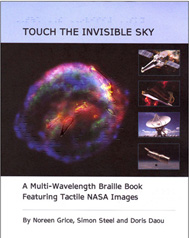
Touch the Invisible Sky: A Multi-Wavelength Braille Book Featuring Tactile NASA Images

This unique book combines large print and contracted Braille
with colorful tactile images as seen through the eyes of
multi-wavelength telescopes. Stunning images compare
celestial wonders in visible, X-ray, infrared, ultraviolet
and radio waves and provide views not seen through human
eyes.


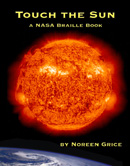
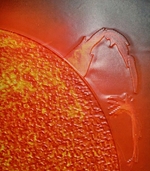
Touch the Sun (published in 2005) -- to order Touch the Sun, click here contains embossed color images of our dynamic sun including sunspots, eruptions, magnetic fields and space weather.

(samples of images in Touch the Sun, Steele Hill, Goddard Space Flight Center)
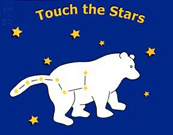
Touch the Stars is a Braille/Large print astronomy text with tactile line drawings. This book covers a variety of general astronomy topics including constellations, planets, moon phases, eclipses and galaxies.
Image of Touch the Stars
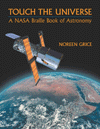
Touch The Universe: A NASA Braille Book of Astronomy makes the universe accessible for readers of all visual abilities! Touch The Universe was funded by a NASA grant received by Dr. Bernhard Beck-Winchatz of DePaul University. Noreen Grice developed the text and tactile illustrations. Benning Wentworth II (Colorado School for the Deaf and Blind) evaluated the tactile images with his students.
Image of Touch the Universe
Designing useful tactile images requires thoughtful testing with visually impaired readers.
Back in 1988, Noreen Grice used a Versapoint-40 Braille embosser to create astronomy-related tactile illustrations. The picture below is one of her earliest tactile images of the phases of the moon. The moon is seen orbiting the earth. Each moon phase is raised. Sunlight is shown coming from the right side of the picture. The Versapoint-40 tactile images were tested with visitors at the Boston Museum of Science.
In this prototype image of Jupiter raised, students at the Colorado School for the Deaf and Blind tested the prototype illustrations. In this image, raised curves represent gas currents and the great red spot is seen as a swirling oval.

The final Jupiter tactile image from Touch The Universe, appears in the picture below